law

2443673181 22b94312fe Do you Know When a Motion to Dismiss Should be Made?

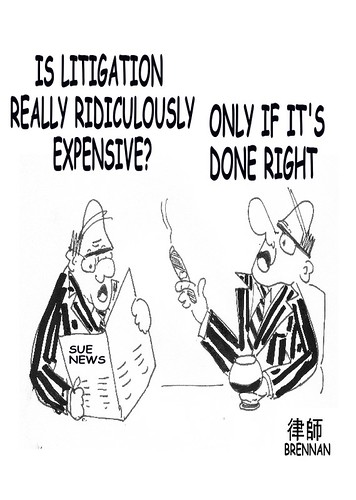
You know that litigation could be expensive.  If your attorney is a Linchpin he will always present an analysis of the costs of defending a lawsuit to you.  Great attorneys are often able to limit the costs of litigation while continuing to defend you aggressively. Bad attorneys make lots of money by drafting unnecessary motions.

Some judges don’t allow for discovery motions, preferring issues such as the re-scheduling of depositions to be resolved at a conference. “Snake” attorneys will make the motion anyway, viewing it as a billing opportunity.

If you are subject to a lawsuit, one of the tools in your lawyers’ toolbox is a motion to dismiss. If you win a motion to dismiss, your case is over in one sweeping step.  However, if you lose and your motion is denied, your litigation costs become more expensive.  The rule outlining a motion to dismiss is CPLR section 3211. Because of its costs, the decision of whether you should make a motion to dismiss should not be taken lightly.

What should you look for when making a motion to dismiss?

  • You should first review and pick apart the complaint.
  • Does the plaintiff (the person who is suing you) state a cause of action?
  • Are there any legal defects to the complaint?
  • Does the complaint make factual sense?
  • Do you have all the facts? In many cases, you need paperwork from the plaintiff, such as a contract.
  • Does the court have the right to hear the case?
  • Are you or your company subject to the court’s jurisdiction?  For example, if your company is being sued in New York but has never conducted business there, a motion to dismiss could be appropriate.
  • Statute of Limitations. The action may not have been timely filed.

What you need to tell your Attorney

  • If you company has been sued, find out the person who has the most knowledge regarding the lawsuit.
  • Write a detailed summary of the facts
  • Notify him of any witnesses with their address, email address, Twitter account and phone number.
  • Provide all documents related to the lawsuit.

When is winning a motion to dismiss a waste of time and money?

Just because a motion to dismiss can be made, doesn’t mean that it should. There are times when winning a motion to dismiss will not dispose of the case

  • If you were improperly served, but the case is still well within the statute of limitations, the plaintiff can simply re-serve you.  
  • If there is a technical defect which can be easily changed by an amended pleading, such as the misspelling of your name?
  • In some instances, by making a motion to dismiss you may alert the plaintiff of your defenses or missing information.

When should you make a motion to dismiss even if you will probably lose?

  • For tactical reasons, you may decide to show the opposition that you are ready to go to war.
  • You can obtain facts about the case earlier than waiting for formal discovery, which could take years.

As a defendant, you should always look to settle the case before a motion dismiss is made or an answer is filed. The vast majority of cases are settled before trial.  Everyone is aware that the settlement is not a sign of weakness because of the high cost of litigation.

If you or your company has been subject to a lawsuit, contact me at the Law Office of Frederic R. Abramson at 212-233-0666.

irs penalties and interest What are the penalties for misclassifying an independent contractor?I have a technology company as a client who recently retained my office to advise them on a relatively common employment law. The company signed a contract with financial institution to perform help desk related work.  They hired ten people to perform the work and had each of them sign an independent contractor agreement.  All of the workers performed the work on the job site only. The all worked solely for the technology company for 40 hours a week. The company just received an evil notice from the IRS. The IRS believes that the workers are misclassified as independent contractors and should be employees.

The technology company now wonders if there are penalties for misclassifying the workers as an independent contractor.  The IRS looks in part at the intent of the employer.  If the IRS reclassifies a worker from independent contractor to employee, the employer may be liable for a penalty based on the amount of the tax that was not withheld because of the original misclassification. If the IRS finds that the misclassification was an honest mistake on the part of the employer, and the employer filed proper returns, the penalty against the employer is:

• 1.5% of the wages paid to the employee; and

• 20% of the amount that should have been withheld from the employee’s wages for FICA, but was not due to the misclassification.

If the IRS finds that the employer failed to file the proper returns, then, except where the failure is due to reasonable cause and not willful neglect, the penalties double. Then, the penalties are:

• 3% of the wages paid to the employees; and

• 40% of the amount that should have been withheld from the employee’s wages for FICA, but was not.

If the misclassification on the part of the employer is intentional and therefore the employer intentionally neglected to withhold the necessary employment taxes, the limits discussed above do not apply in assessing the employer’s liability. The penalties for intentional misclassification are more severe. Moreover, the limits are not applicable to the employee’s share of the FICA taxes if the worker is a “statutory employee,” nor where the employer withholds federal income tax from the worker’s wages, but does not withhold FICA.

Lastly, if the required to pay an “employee reclassification” tax liability, the employer may not recover the tax assessed from the employee. In addtion, the employer may not deduct the amount of tax assessed from the employee’s wages. The Internal Revenue Code provides further that the employee’s liability for his or her share of the tax is not affected by the assessment or payment of the penalty tax by the employer.

If you have a legal question regarding independent contractors in New York, contact the Law Office of Frederic R. Abramson at 212-233-0666

“Art,” Linchpin, Seth Godin and the Law

by Fred Abramson on April 14, 2010 · 2 comments

pollock lavendermist Art, Linchpin, Seth Godin and the Law

This post has nothing to do with the law. It’s about art. I am not talking about art in the traditional sense, like Jackson Pollack or Pablo Picasso. I am talking about the art that you bring to your work and to your life.

In our economy, you are no longer guaranteed lifetime employment. The publishing industry is in upheaval. GM is running on fumes. The insurance company that you work for could be bought out tomorrow.  Just because you have depth of knowledge doesn’t mean that your job is secure. It doesn’t matter if you own your own company or you are an employee. The only way to get your worth is to stand out. You need to be seen as indispensable and to produce interactions that people care about. Seth Godin says that you need to be what he calls a “Linchpin.” (Read his thought provoking book). Now, success means being an artist.

To quote Seth Godin:

“Be remarkable. Be generous. Create art. Make judgment calls. Connect people and ideas … and we have no choice but to reward you.”

Every morning after dropping off my kids at daycare, I work to be a remarkable attorney. I am generous with my time. My art is providing legal services that are tailored to you. I write articles nearly every day working to educate you. You are paying me for my knowledge of the law and my intellectual ability to make judgment calls for you.  My goal is to connect you with the rest of my tribe.  Hiring a lawyer should be a unique experience for you and I work to make your life better.

I understand that you have a variety of options when choosing an attorney.  You may decide that you may want to hire a lawyer that costs less money. You may think that I don’t handle an area of law, like real estate and don’t bother calling me (yes I do handle real estate closings).  That’s all ok. I’m here to let you know that you know that I am here for you and for all of your legal needs.  No, I don’t handle every area of the law, but I probably know a lawyer who can help.

Let me know what you think about Seth Godin’s words and continue to do good work.

The Law Office of Frederic R. Abramson practices the art of law in New York State.  You may contact me at 212-233-0666

 Art, Linchpin, Seth Godin and the Law

4479593931 fff24b2a5d Killer Lessons for Lawyers and Entrepreneurs from ReworkMy commute from the lovely North Shore of Long Island to the New York Supreme Courthouse near Chinatown in Manhattan is an hour journey.  I devoured the new business book entitled Rework by @jasonfried and David Hansson in one round trip.

Unlike most business books, Rework is the product of real life successful entrepreneurs.   These guys are not “gurus.” They provide advice that is easy to read and visually appealing.  The visual aspect reminds me of Tom Peters who wrote one of the best business books ever In Search of Excellence.

As a business law attorney, I read this book with an eye towards small businesses and its applicability to the practice of law for small firms.  Feel free to join in and post your thoughts.

  • Make a dent in the universe. You should feel a sense of urgency about this because you won’t be here forever.  As an attorney, your work is your  life’s work.  If you think that it sucks making a living as an insurance company whore (insurance defense attorney) then  quit.  Go work for legal aid if that makes you happy.
  • Ideas are cheap and plentiful. The real question is how you execute. When the economy started tanking you just knew that bankruptcy’s would soar.  But what did you do to go out and get you some of that business? Probably nothing.
  • You can’t recognize the details that matter most until after you start building. That’s when you see what needs the most attention.  If you want to start video blogging about ten things you should know before entering into a contract you should just look into your cam and do it.  You can then graduate to a flip camera. If you are telegenic, you may one day even become a YouTube star.
  • Commit to making decisions. Don’t wait for a perfect solution. Decide and move forward. Decisions are progress. Lawyers often agonize over hiring the best web designer for their new blog.  Instead of making a decision, they wait and wait and wait…..and guess what? No decision.  Decide and move on.
  • Quick wins. The way that you build momentum is by getting something done and then moving to the next thing. Don’t spend too much  time lingering on Facebook, checking out your friends artwork. (But you should check out the link which leads you to the work of my friend Michael Sprouse).  After entering your billing, start preparing for tomorrows deposition.
  • If you think a competitor sucks, say so. If you are a solo, tell the world that you hate big law firms. It is a great way to differentiate yourself. Hell, I do.  I especially hate them when I go to court.  They have no clue how to draft a simple order. They love to make useless motions so that they can bill the fuck out of their clients. Sitting through a deposition with a newly minted big law associate is torture.  ”When you started your first company at the age of 12, was your mother working as a waitress or a podiatrist?”
  • Don’t spend much time focusing on competitors. Focus on yourself instead. Here in New York City, this would cause serious anxiety due to the plethora of lawyers.
  • Say no by default. If your clients want you to say yes to a deadline that is too optimistic, you probably won’t meet it.   You will lose the client anyway. It is best to explain why their expectations are impossible to meet. If they won’t except it, let the next sucker attorney deal with it.
  • Build an audience. Speak, blog, tweet-whatever.  Share info that’s valuable and you’ll slowly build and audience. Unless you are personal injury or criminal attorney with a Warren Buffet sized war chest, lawyers shouldn’t waste their time on ads.
  • Instead of trying to outspend, outsell, or out sponsor competitors, try to out-teach them. Use your blog to teach the world about what you do.
  • Emulate chefs. Share everything that you know. For lawyers, posting all of your documents is your cookbook. Cooks can’t copy Batali.  Why not crush Legal Zoom and post everything for free?
  • Go behind the scenes. Hell, people watch ice road truckers. Lawyers can take a flip camera and with court permission, film.

If you want to do something, do it now. Inspiration is perishable.  What do you think?

 Killer Lessons for Lawyers and Entrepreneurs from Rework

4 Ways to Protect Your Small Business from Fraud

March 31, 2010

Share

Fraud is not limited to the Bernie Madoff’s of the world.  Because of the recession, it should come to no surprise to learn that financial problems are more likely to lead to more fraud.
Fraud is a huge problem.  According to the Association of Fraud Examiners 2008 report on occupational fraud and abuse, companies lose 7 [...]

Read the full article →

Wage Garnishment: What should you do?

March 24, 2010

Share
Wage Garnishment is a very powerful tool for either the government (most commonly the IRS), a company or an individual to collect money damages.  If you are a plaintiff in a civil action, if you obtain a judgment you may be able to have the sheriff garnish the wages of the person you are suing.
If [...]

Read the full article →

What Litigation Costs and Expenses are Recoverable in NY? How about Attorney Fees?

March 19, 2010

Share
Nearly every lawsuit asks for recovery of attorney fees, costs and expenses for bringing the action.  When potential clients contact my office for the first time for a civil litigation matter, the most common question asked is whether attorney fees are recoverable.
Attorney fees are generally not recoverable.  There are exceptions to this rule, such as when authorized by [...]

Read the full article →

NY State Court Civil Litigation- Why Case Investigation is Vital

March 19, 2010

Share
If you are planning to start a lawsuit in New York State Court, one of your first tasks is helping you lawyer investigate the facts of your case.  Believe it or not, case investigation of your civil litigation matter begins before you walk into your lawyers door and may not end until a judgement has [...]

Read the full article →

LLC New York Business Taxation

March 3, 2010

Share

The IRS allows owners of LLC’s to make the decision themselves about how they want the company to be taxed.  The LLC can be taxed as in two general ways:

As a pass-though entity, like a s-corporation, sole proprietorship
Like a c-corporation

What is a pass though entity?
Usually business owners planning on forming a LLC at the startup [...]

Read the full article →